Clinical / Healthcare · Dense Data UX · Expert Workflows · Information Design
Caris Life Sciences · Results Review
Redesigning an expert-facing cancer-results review tool to reduce visual load, improve scanability, and better match how geneticists move through dense clinical data.
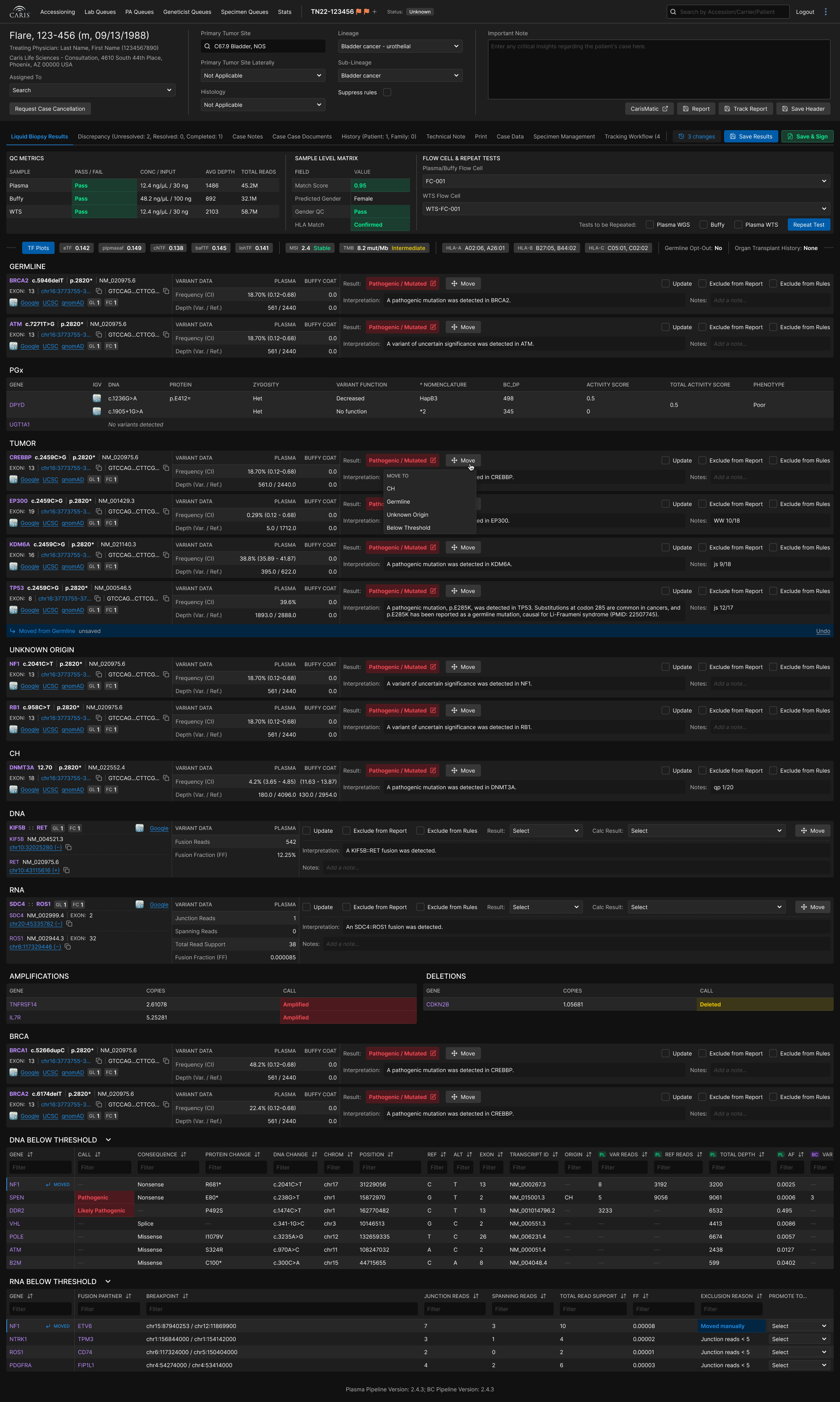
Overview
Caris uses an internal results-review tool to help geneticists interpret complex cancer testing data. The existing experience was highly dense, visually demanding, and needed to support additional data without making an already information-heavy workflow harder to use. The redesign focused on improving scanability and helping experts review information more efficiently throughout the day.
My Role
I worked directly with geneticists and lab technicians to understand how they read the screen, what information they prioritized, and how their eyes moved through the workflow. I came into the project with prior laboratory experience, which helped me quickly understand the domain and ask more targeted questions.
What began as a request to update a few sections grew into a broader redesign of most of the experience. I worked iteratively with stakeholders to make sure the layout, hierarchy, and interaction patterns reflected how they actually reviewed results.
Approach
The challenge was balancing readability with density. These users spend much of their day scanning large amounts of clinical data, so unnecessary movement and spacing created real friction.
I reorganized the page around their natural review flow, strengthened hierarchy, and significantly reduced vertical padding so more relevant information could remain visible at once. The goal was not to make the interface sparse. It was to make a dense interface easier to scan, interpret, and use repeatedly without unnecessary visual effort.
The redesign reduced vertical spacing by roughly 50%, allowing substantially more information to remain visible without sacrificing structure or readability.
Outcome
The redesign expanded well beyond the original scope and was received positively enough that I was brought into additional Caris work. The resulting experience better matched the geneticists' review process, made dense information easier to scan, and created a stronger foundation for adding new data types without increasing visual complexity.